.svg)
Scaling EVM Execution: Benchmarks from the Altius Tech Stack
.png)

Altius is a high-performance execution stack designed for teams building new L1s and L2s that require materially higher throughput than today’s sequential EVM execution model can support.
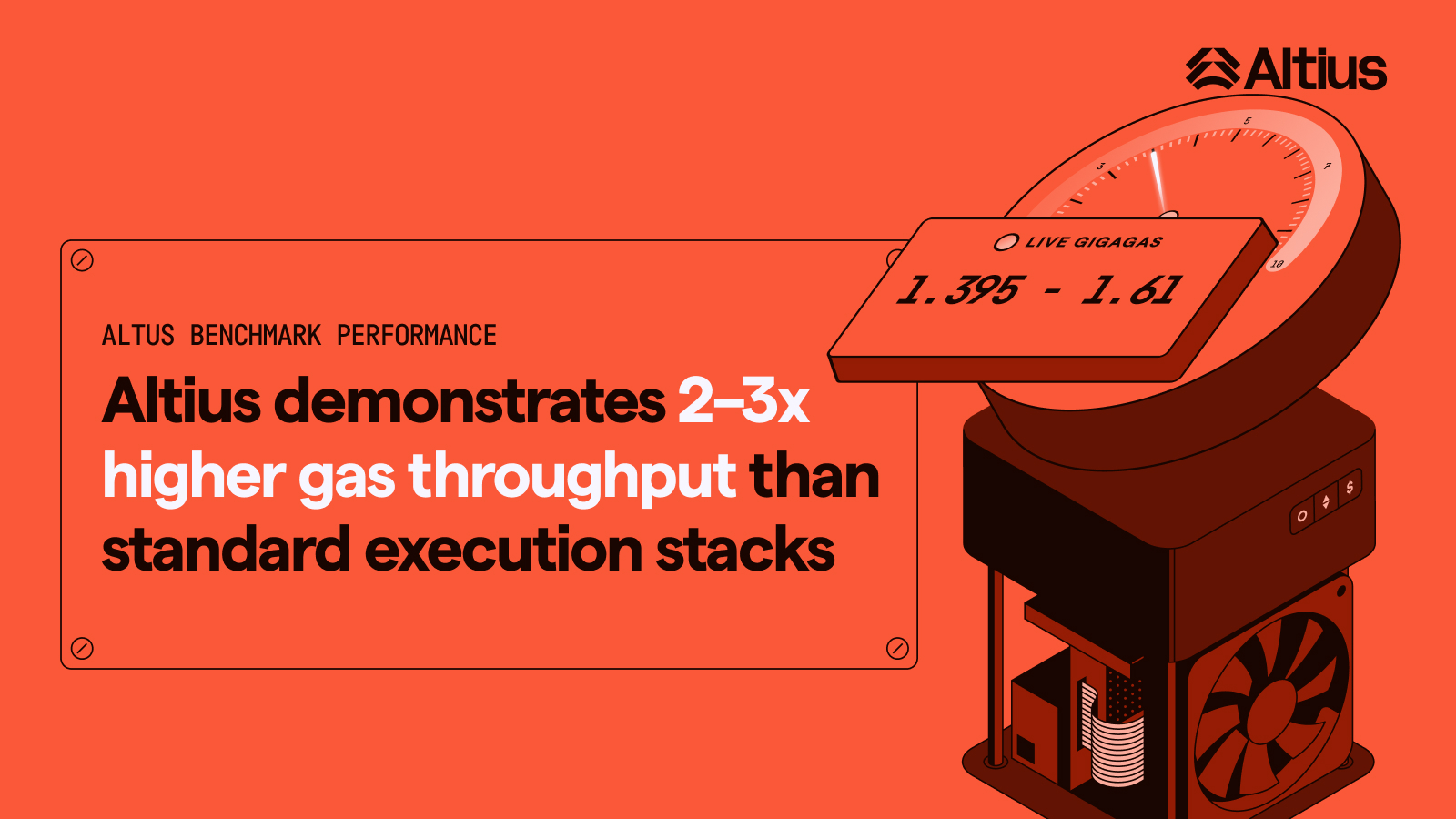
In controlled, reproducible benchmarks using Ethereum Mainnet and Base Mainnet data, Altius demonstrates 2–3x higher gas throughput than standard execution stacks under the same assumptions. These gains come from architectural changes to how execution is scheduled and how execution is decoupled from known bottlenecks.
For builders evaluating execution as infrastructure, these benchmarks provide a clear view into what is possible when execution is treated as a first-class system component rather than a legacy constraint.
TL;DR
For those familiar with standard execution engines like Geth (Ethereum Mainnet) or the standard OP Stack (used by Base), Altius represents a fundamental architectural shift from sequential to parallel execution.
When comparing Altius to the industry standards, the performance gap is significant:
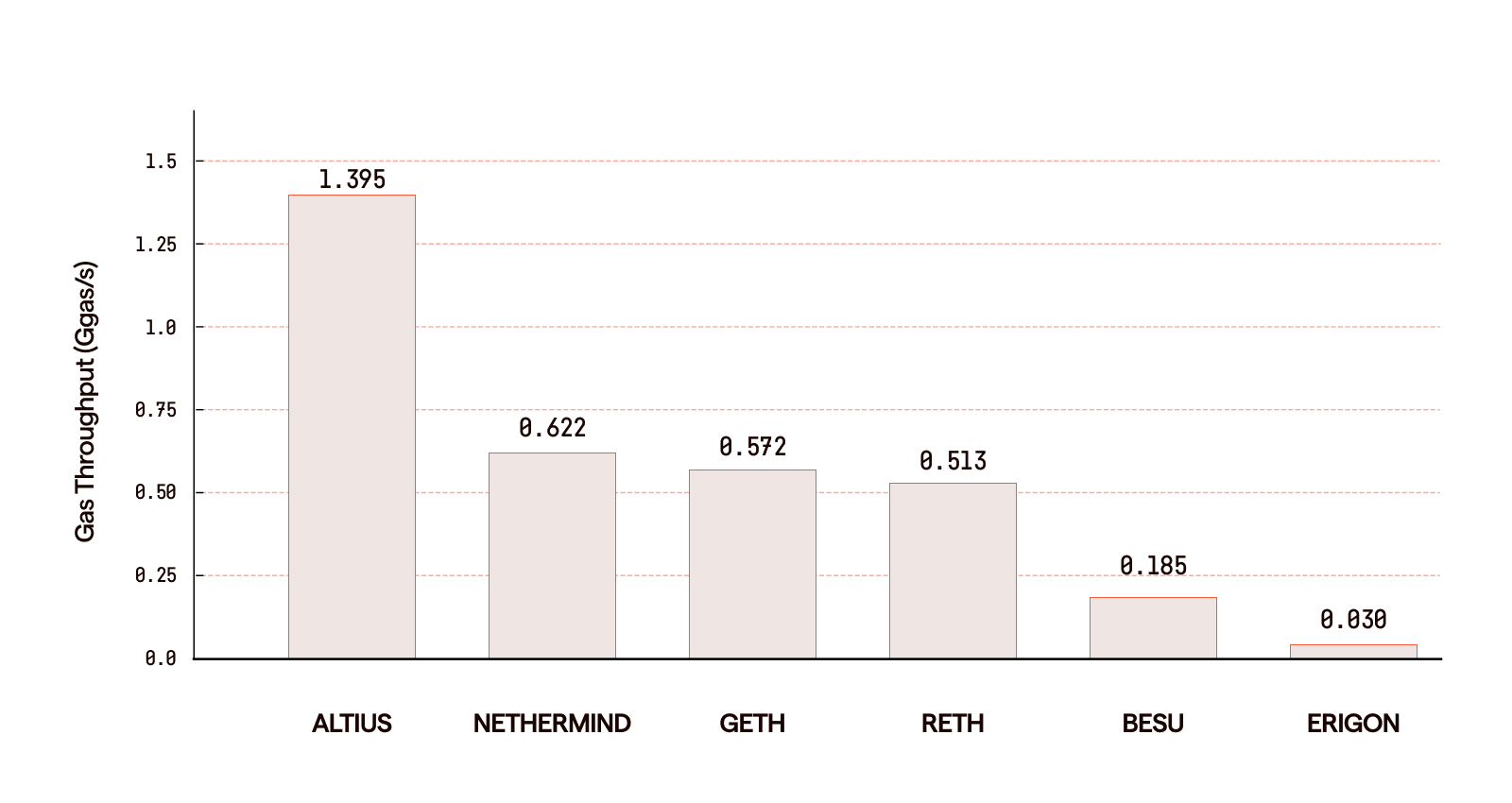
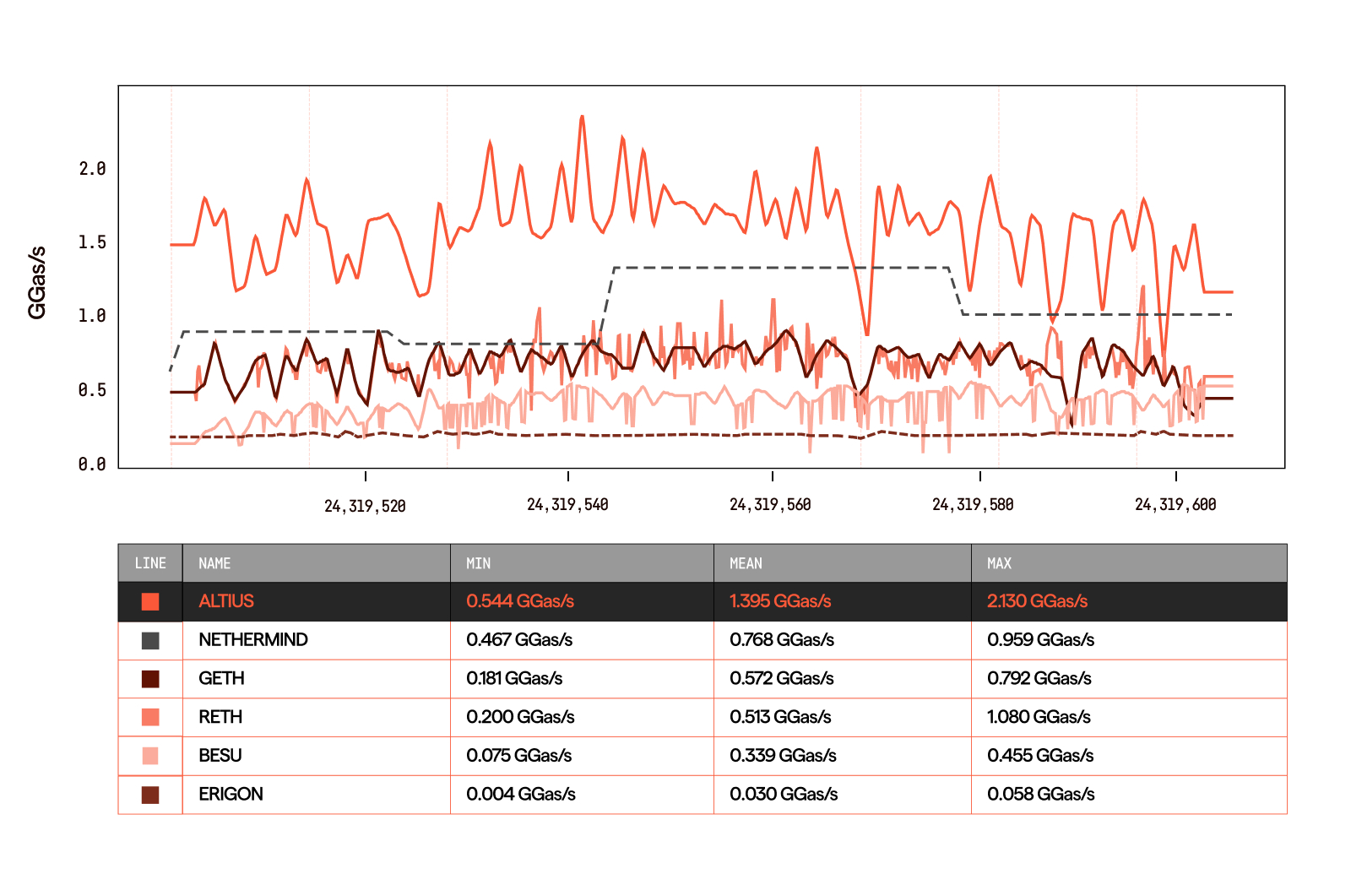
- Altius vs. Geth (Ethereum Mainnet): While Geth operates at roughly 0.572 Ggas/s, Altius achieves 1.395 Ggas/s — a 2.44x performance increase over the most widely used client. Altius is currently the only client capable of crossing the 1.0 Ggas/s threshold required for institutional High-Frequency Trading (HFT).
- Altius vs. Base (OP Stack): On L2 infrastructure using Base Mainnet data, the standard sequential execution baseline is 0.55 Ggas/s. Altius accelerates this to 1.61 Ggas/s, delivering a 2.92x speedup even in high-contention environments.
How Did We Do This?
The stack addresses two structural bottlenecks that dominate execution time in existing systems:
Parallel Execution by Design
Most production EVM clients execute transactions sequentially. Some newer systems attempt optimistic parallelism, speculating on conflicts and reverting when they occur.
Altius uses deterministic parallel scheduling, constructing a dependency graph that ensures non-conflicting transactions are executed concurrently without rollback. This avoids wasted work under contention and produces stable, predictable performance.
Decoupling Execution from Known Bottlenecks
In standard clients, transaction execution is tightly coupled to operations such as state root calculation and cold state access. These operations can dominate block processing time and obscure the true execution capacity of the system.
Altius explicitly separates execution from these bottlenecks so that execution throughput can scale independently as supporting infrastructure evolves.
Benchmark Assumptions
Transparency is the cornerstone of our benchmarking. These benchmarks are intentionally designed to isolate execution performance.
Every assumption is applied consistently across L1 and L2 tests. To achieve these numbers, we made two strategic technical assumptions that reflect the future direction of the Ethereum ecosystem:
Assumption 1: Deferred State Root Calculation
State root computation (Merkle Patricia Trie hashing) can account for 40–50% of block processing time in production clients. In our benchmarks, state root calculation is offloaded to our Scalable State Merkle Tree (SSMT) implementation to allow the engine to focus purely on transaction throughput.
This allows the execution layer to process transactions without waiting for the intensive cryptographic commitment of the Merkle Patricia Trie. This approach is increasingly supported by the broader research community and reflects a realistic deployment model where execution is separate from finality.
Assumption 2: Warm State via Access Lists (EIP-7928 Model)
We utilized optimized access lists and the BAL proposal framework to streamline how the engine interacts with state data, significantly eliminating cold-state I/O during execution. This models future EVM behavior and reflects how high-throughput L2s already operate in practice.
This assumption is especially important in high-contention environments, where cold reads amplify latency and conflict penalties.
These assumptions help to isolate execution performance so system designers can reason clearly about scaling limits and tradeoffs
Scenario: L1 Altius Execution Stack Benchmark (using Ethereum Mainnet Data)
Goal: Measure execution throughput under Ethereum Mainnet workloads using a consistent execution-only configuration.
Setup
- Hardware: OVHcloud Advance-2 (AMD EPYC 4344P 8-Core, 64GB DDR5, NVMe SSD)
- Dataset: 100 sequential Ethereum Mainnet blocks (24,319,506 – 24,319,605)
- Metric: Gas Throughput (Ggas/s) via sequential Engine API processing
Results
Altius demonstrated superior gas throughput, outperforming all major production clients by significant margins.
.jpg)
Scenario: L2 Altius Execution Stack Benchmark (using OP Stack with Base Mainnet Data)
Goal: Validate Altius integration into the OP Stack using real-world Base Mainnet data, which represents a high-contention L2 environment.
Setup
- Hardware: AWS EC2 r7i.2xlarge (Intel Xeon Platinum 8488C, 64GB DDR5, 7.1TB EBS)
- Dataset: 10 consecutive Base Mainnet blocks (38014901 – 38014910)
- Environment: High contention (~70% of transactions touch overlapping state)
- Comparisons: Altius Parallel Engine vs. Baseline Sequential Execution (standard op-reth behavior)
Results
Even under high contention, Altius delivers nearly 3x higher throughput and materially lower execution latency. The combination of deterministic parallelism and enforced access lists allows the system to scale without stalling under conflict-heavy workloads.
Altius successfully resolved architectural hurdles (such as the bundle state protocol and L1 settlement dependencies) to deliver significant gains:
.jpg)
In L2 environments, the addition of Access Lists (EIP-7928) allowed Altius to manage Base's 70% conflict rate without stalling, proving viability for high-throughput sequencers.
By running on the OP stack with Base blocks, we’ve demonstrated that our engine can handle the most demanding L2 traffic in the industry with significant headroom to spare.
Why This Matters
Execution throughput is becoming the dominant constraint for both L1s and L2s. Incremental optimizations to sequential execution cannot entirely close the gap required for next-generation applications.
Altius demonstrates that:
- Execution can scale independently of legacy bottlenecks
- Parallelism can be deterministic and stable under contention
- A single execution stack can support both L1 and L2 deployment models
By isolating execution from known bottlenecks and designing for deterministic parallelism from first principles, Altius delivers step-function improvements in throughput for both L1 and L2 environments.
For builders evaluating execution as infrastructure, these benchmarks provide a clear view into what is possible when execution is treated as a first-class system component rather than a legacy constraint.
Open Source & Verification
We believe in don't trust, verify. All benchmarking tools and configurations used for this report are being made available to our partners and the open-source community.
Ready to build for the future? Check out the Altius Documentation.
Altius is an execution stack built for systems that need exceptional performance.
Contact Us
To begin the integration process or to request access to the Altius private repository, please reach out to our team at bd@altiuslabs.xyz. We look forward to helping you build the next generation of high-performance digital infrastructure.