.svg)
The blockchain built to stay fast as it grows
Every blockchain eventually runs into the same wall. As adoption grows, as more contracts deploy, as state accumulates block after block, the network that once felt fast starts to strain under its own success. Validators fall behind, state growth chokes execution, and the very success a chain was designed for becomes the thing that slows it down.
Altius was built to break that pattern.
The problem with traditional chains
Most blockchains are built around a simple trade-off. To get the decentralization and credibility of a public network, you give up raw performance. Consensus has to be reached across many independent validators, state has to be verified by every node, and execution has to happen sequentially to preserve consistency.
That formula works, but it does not scale gracefully. The more a chain is used, the heavier its state gets, and the heavier its state gets, the slower everything downstream (block production, state root computation, finality) becomes.
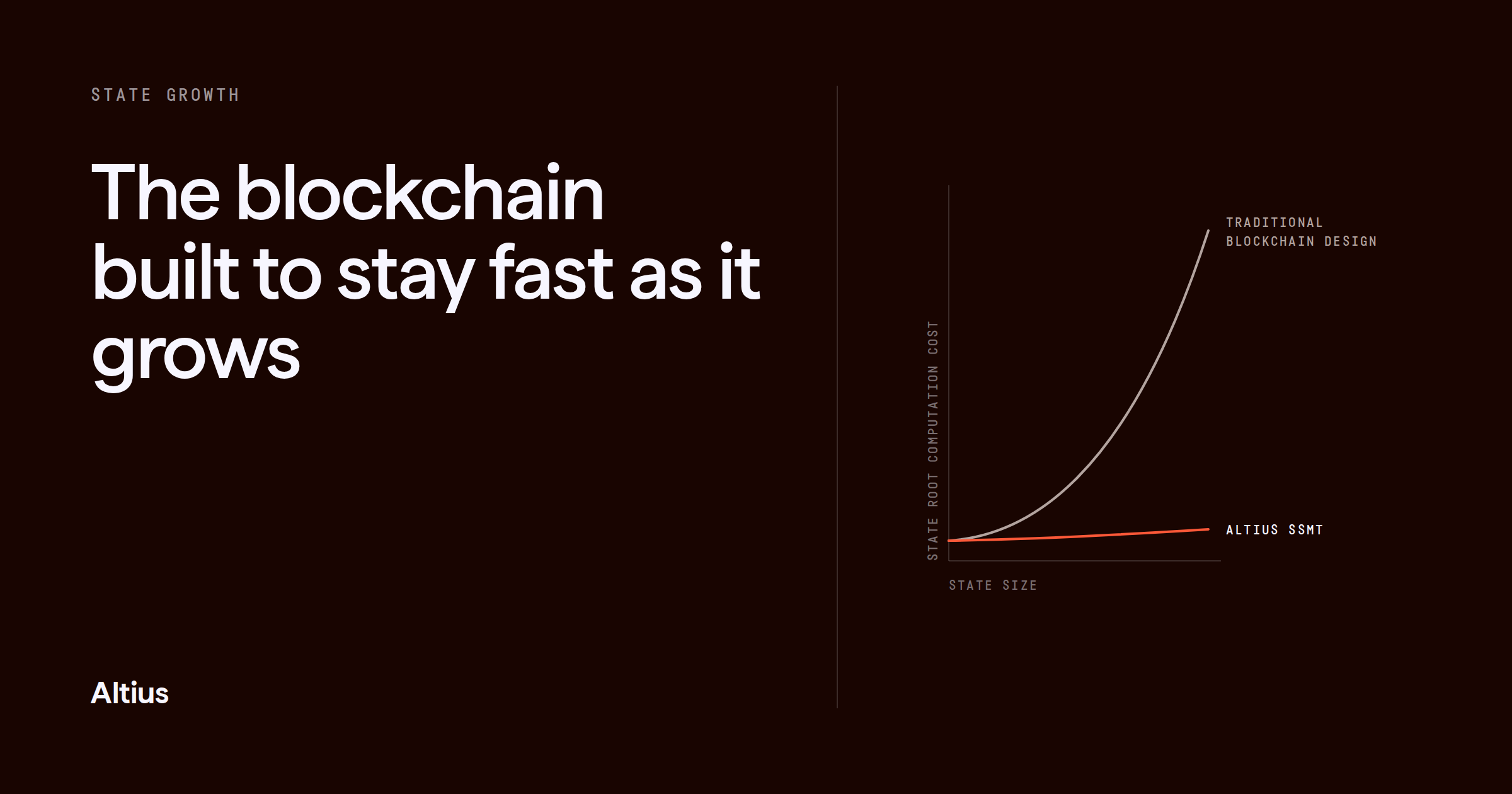
The point is the trajectory. Individual clients have made progress on the cost of computing a state root. What none of them have changed is where that cost is paid: In traditional blockchains, the client stops, computes the root in sequence, and cannot move on until it has one.
Altius moves that work into its own process, on its own set of cores, computed many parts at a time. The work still grows as state grows but it’s no longer a serial step inside the client.
Financial applications need performance they can predict. A traditional blockchain that slows down as its history accumulates cannot offer that.
The Altius approach
Rather than compromising on decentralization or compatibility to buy speed, Altius separates concerns that most chains bundle together. Settlement, execution, and state computation each get their own purpose-built layer, so the system that handles security doesn't have to also carry the burden of high-frequency execution, and the layer that needs to move fast isn't held back by consensus overhead.
That separation is what the rest of this post describes: a settlement layer built to be operated, a coprocessor for the workloads a general-purpose chain can't serve, and a dedicated engine for the state computation that would otherwise slow the settlement layer down.
The three layers
Altius L1: the settlement layer
Altius L1 is the underlying network, an EVM-compatible blockchain that acts as the ledger for every valid transaction. Compatibility with the EVM means that existing smart contracts, ABIs, and JSON-RPC tooling work against it unchanged.
Altius L1 targets 60ms block production, with deterministic finality at roughly the same interval. Underneath, fast BFT consensus and fixed-interval block production are designed to remain stable even when financial activity spikes.
Altius HPEC: the execution coprocessor
Altius HPEC is a separate, high-speed lane built specifically for the fastest, most demanding activity. HPEC is purpose-built for the workloads of time-sensitive financial markets, targeting 10,000+ transactions per second with sub-ms execution.
Because it runs outside of the Altius L1, HPEC HPEC isn't bound by the coordination overhead that slows a chain down as more participants join. Improving performance is as easy as spinning up an additional instance or upgrading the hardware.
While execution happens off-chain, custody does not. HPEC settles committed results back to Altius L1, targeting 60ms, with on-chain contracts enforcing custody, state commitments, and a forced-exit path that makes it possible to recover assets directly from the chain if the coprocessor becomes unavailable.
SSMT: the state-root engine
Every chain stores a state root, which summarizes every account's holdings and every contract's data at a given point in time. In traditional blockchain design, the amount of compute required to produce the state root grows alongside the network. The more a traditional blockchain gets used, the more information it has to keep track of, and the slower it gets, similar to a filing system that gets harder to search the more documents you add.
SSMT moves that computation into a dedicated, multi-threaded engine. SSMT splits that computation across many processor cores on a single machine, and moves it off the execution client's critical path. With SSMT, computing the state root is no longer one of the steps the client works through in sequence, so the time it adds to the execution of a block is a fraction of what it would be otherwise.
What this means for institutional operators
Banks, exchanges, payment processors, and other regulated financial institutions can't treat blockchain infrastructure like an experiment. They need guarantees that hold up under legal and operational scrutiny, alongside performance that doesn't buckle during the exact moments their business depends on it most. Altius was designed with that reality in mind.
Governance and control that regulated organizations actually need. Enterprises can't just plug into a network and hope for the best. Altius L1 comes with on-chain governance, access controls, and a managed validator lifecycle built in, so the platform is designed for a company to operate its own piece of the network the way it would run any other piece of regulated infrastructure.
Auditability as a default. Compliance teams need to be able to see what happened and when. Altius includes rich administration and audit interfaces built-in, making targeting specific compliance frameworks possible.
Custody stays where your risk team can see it. Because assets sit in on-chain contracts on Altius L1 and the forced-exit path is enforced there, the custody question has an answer enforced on-chain.
Flexibility to configure the network around your business. Configurable fee tokens and a control plane designed for institutional operators mean an enterprise isn't stuck adapting its business to the chain's defaults. The operator chooses everything, including which token fees are denominated and settled in; they can even sponsor all gas costs making the network free to use.
Conclusion
Traditional blockchain design forces a choice between being trustworthy, being fast, and staying fast as they grow. The Altius stack was built so that none has to be sacrificed for the others—three separate problems solved at once, working together as one system, and designed to have the same high-speed performance in year five as it did on day one.