.svg)
Why Building a High-Performance Blockchain Is Harder Than It Looks

Why Building a High-Performance Blockchain Is Harder Than It Looks
The pitch always sounds straightforward: build your own chain, control your fees, your data, your throughput, and ultimately own the rails your business runs on.
But once you start building, reality sets in quickly. What initially feels like a product decision becomes a complex engineering challenge spanning consensus design, validator economics, state storage, compliance, APIs, and security, all of which must work reliably together under real production load.
This is where expectations and reality diverge. Building a blockchain from scratch requires more time and money than most organizations anticipate, and even once it works, the work does not stop. It still needs to be maintained, upgraded, and secured across every layer. Many enterprises spend years trying to reach production readiness, and a significant number never fully get there.
The issue is not a lack of ambition. High-performance blockchain infrastructure is genuinely difficult to build, requiring expertise in distributed systems, parallel execution, consensus design, and institutional-grade security. These are rare skills, expensive to hire for, and not something most organizations can assemble quickly.
What "High Performance" Actually Requires
When enterprises say they want a fast blockchain, they usually mean predictable throughput, low and stable fees, fast finality, and the ability to scale without degradation. The challenge is delivering all of these at once. It requires careful trade-offs, and optimizing for one dimension in isolation often produces systems that look strong in controlled environments but break down under real-world conditions.
Throughput alone is not a meaningful benchmark. A chain that can process 100,000 TPS in a stress test but suffers fee volatility or latency under mixed workloads is not production-ready. Finality is just as critical, especially for financial use cases where probabilistic settlement is not acceptable. Compliance is another area that cannot be treated as an add-on. It must be embedded into the architecture from the beginning.
Enterprise adoption requires platforms that meet strict expectations for performance, privacy, resilience, and auditability at scale. This is not a simple feature set. It is a comprehensive engineering discipline.
The Real Cost of Starting From Scratch
Beyond the technical complexity, building from scratch introduces significant organizational risk. Timelines often extend beyond initial projections, specialized hiring takes longer than expected, and security vulnerabilities, particularly in custom consensus implementations, can have serious consequences.
In many cases, by the time a custom-built chain reaches production maturity, the business requirements it was designed for have already evolved. This creates a mismatch between the system and the needs it was meant to serve.
Enterprises frequently underestimate the optimization required to achieve both scalability and performance, which drives up development time and infrastructure costs. These challenges are not edge cases. They are the norm for teams without prior experience building such systems.
A more effective approach is not to avoid blockchain infrastructure altogether, but to access institutional-grade capabilities without taking on the full burden and risk of building from scratch.
What Altius Offers Instead
At Altius, we offer a full-stack solution that gives enterprises access to high-performance blockchain infrastructure without having to build it themselves.
A dedicated enterprise chain powered by Altius gives organizations control over performance, compliance, and data, while maintaining near-zero, stable transaction fees, configurable permissioning, custom privacy modules, and seamless integration with existing systems such as APIs, authentication, and identity management.
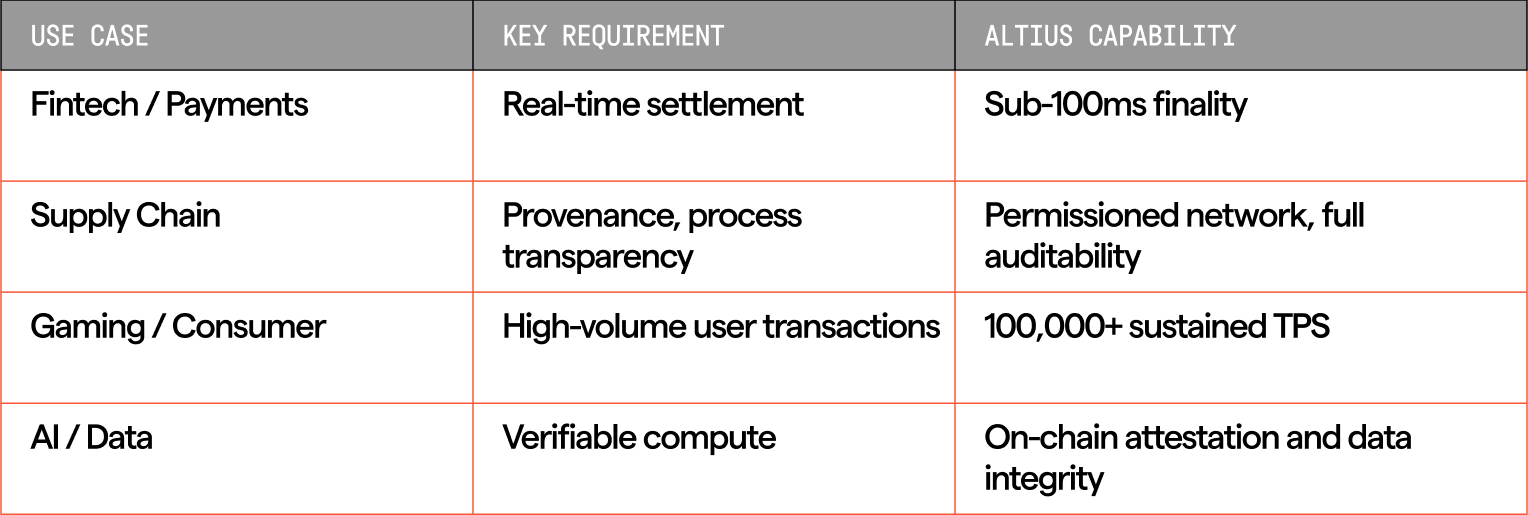
Performance is built for real-world usage, not benchmarks. Finality can be reached below 100 milliseconds under production load, and sustained throughput exceeds 100,000 TPS. The system is built by a team with backgrounds in high-frequency trading, distributed systems engineering, and institutional cybersecurity.
The use cases we support range from fintech settlement and real-time reconciliation to supply chain tracking, high-volume consumer applications, AI compute verification, and IoT data validation. Across all of them, the underlying requirement is the same: infrastructure that performs reliably when demand is real, not theoretical.
Implementation follows a four-stage process: architecture design and co-scoping, a pilot launch within weeks, production chain build, and full-scale rollout with enterprise SLAs and dedicated support. The goal is to validate the business case in a live, scoped environment before committing to full production, rather than spending two years building before anything runs.
The Infrastructure Question Is Already Being Asked
Tokenized real-world assets surpassed $25 billion onchain in 2025, and central banks are actively running settlement experiments on distributed infrastructure. In most boardrooms, the question is no longer whether blockchain belongs in financial systems, but which infrastructure will be ready when real volume arrives.
Building from scratch is one path, but it takes years, requires highly specialized talent, and comes with meaningful execution risk. The alternative is to work with a team that has already solved these challenges. At Altius, we take on that complexity so enterprises can stay focused on their core business.
The rails are ready. The only question is when you’re ready to get on them.
If you’re exploring what a dedicated enterprise chain could look like for your business, reach out at bd@altiuslabs.xyz.