.svg)
Blockchain Scaling Basics: Understanding TPS vs Finality Time in 2025

.avif)
Introduction
Have you ever wondered why sending money across the globe via blockchain can feel lightning-fast one moment and frustratingly slow the next? Picture this: you're trying to buy a rare digital collectible during a hyped NFT drop. Thousands of others are doing the same, and suddenly, your transaction is stuck in a virtual traffic jam. Fees skyrocket, and you're left wondering if it'll even go through before the event ends. This is a classic clash between speed and certainty in the world of blockchain.
In this article, we're diving into the scaling basics, focusing on TPS (transactions per second) versus finality time. We'll break it down like we're chatting over coffee, using simple analogies and real examples from networks like Bitcoin, Ethereum, and Solana. By the end, you'll see why blockchain scalability remains one of the hottest debates in tech.
What Exactly Is TPS in Blockchain?
Let's start with the basics. TPS, or transactions per second, is essentially a measure of how many operations a blockchain can handle in a single tick of the clock. Think of it like the throughput of a highway: How many cars can zoom through per second without causing a pileup? In blockchain terms, a transaction could be anything from transferring crypto to executing a smart contract.
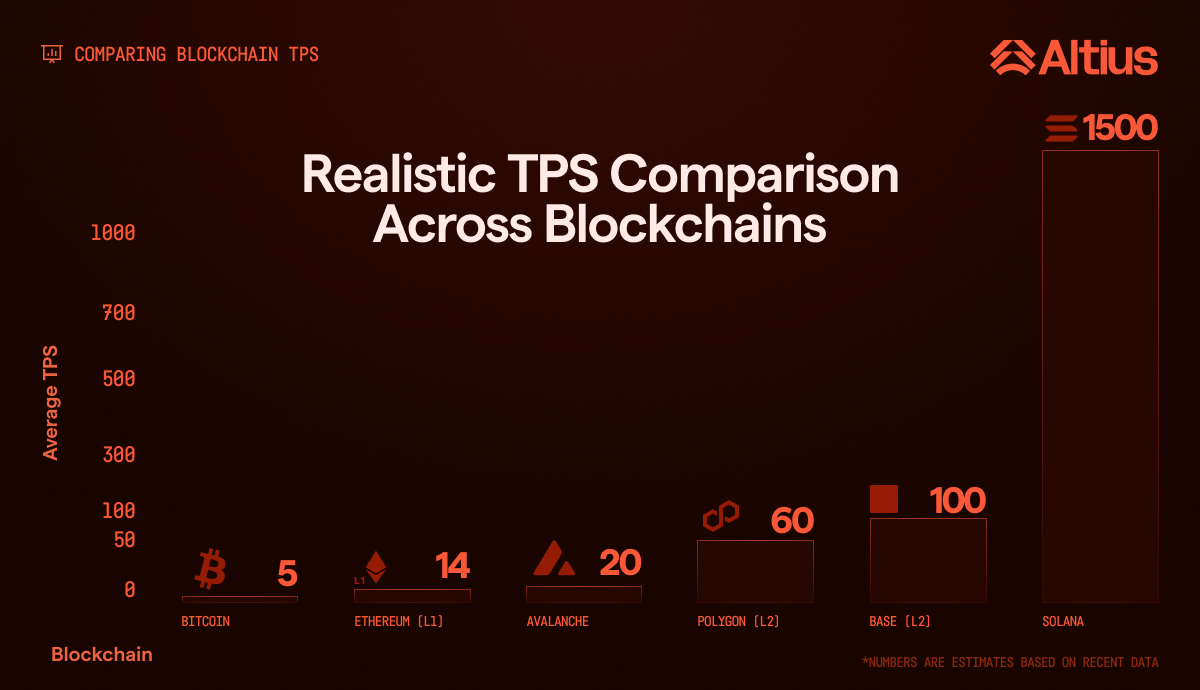
Bitcoin, the OG, clocks in at around 7 TPS. That's fine for its original purpose: secure, decentralized money. But in a world where Visa handles thousands of payments per second, it's a clear performance limitation.
Ethereum, the go-to for decentralized apps, fares a bit better at 15-30 TPS on its base layer. However, during peak times, such as a major DeFi boom, Ethereum's transaction capacity can lead to serious blockchain bottlenecks. Users end up paying exorbitant gas fees just to get their transactions processed, turning what should be a seamless experience into a costly headache.
Now, contrast that with Solana, which boasts real-world TPS figures around 1,133 to 4,700. It's like upgrading from a two-lane road to a multi-lane expressway (while driving a Lexus vs. a Toyota Civic). Solana achieves this through innovative tech like Proof of History, which timestamps transactions in a way that speeds up validation.
But here's where it gets interesting: Higher TPS doesn't always mean a better blockchain. It's worth noting that some experts believe raw TPS numbers can be misleading because they don't account for the complexity of transactions: simple transfers versus intricate smart contracts, for instance.
Decoding Finality Time: When Is a Transaction Truly "Done"?
If TPS is about speed, finality time is about certainty. This is the duration it takes for a transaction to become irreversible; think of it as the point where you can breathe easy knowing no one can undo your deal. In traditional banking, finality might happen in seconds or minutes, but blockchains operate on consensus, which adds layers of complexity.
Take Bitcoin again:Its finality time hovers around 60 minutes for what's considered "safe" confirmation (usually six blocks). Each block takes about 10 minutes, and you wait for a few more to pile on top to minimize the risk of a chain reorganization. It's secure, sure, but in some cases, that wait feels eternal if you're dealing with time-sensitive trades.
Ethereum's finality time is shorter, typically 12-15 minutes, thanks to its shift to Proof of Stake. Blocks finalize after two epochs, giving you that peace of mind quicker than Bitcoin. But Solana flips the script entirely, achieving finality in about 2-5 seconds currently, with 2025 upgrades like Alpenglow promising to slash it to 100-150 milliseconds. That's faster than blinking!
Imagine ordering food online and having it confirmed before you even close the app. However, this speed comes with nuances: Solana's network has faced outages in the past, raising doubts about whether ultra-low finality times sacrifice reliability in high-stress scenarios.
To put it in everyday terms, TPS is like how quickly you can fill a shopping cart, while finality time is how long it takes for the cashier to ring you up and hand over the receipt. You need both to work well, or the whole process grinds to a halt.
The Core Trade-Off: TPS vs Finality Time in Blockchain Scalability
Here's where things get tricky—t the demand for more transactions per second typically goes against the need for shorter finality periods. It's all connected to the scalability trilemma, a concept popularized by Ethereum's Vitalik Buterin.The idea is that blockchains struggle to balance three key pillars: decentralization (no single point of control), security (resistance to attacks), and scalability (handling more users without slowing down). Boost one, and the others might suffer.
For instance, cranking up TPS means processing more data, which can introduce network latency. Nodes (the computers running the blockchain) have to communicate faster, but if they're spread across the globe, delays creep in. That's a classic blockchain bottleneck. Solana tackles this with its high-speed consensus, but critics argue it centralizes power among fewer, more powerful validators, potentially compromising decentralization.
On the flip side, longer finality times enhance security (more confirmations mean less chance of reversals) but they kill usability for real-time apps like gaming or payments. Some experts believe we're seeing a shift: Networks prioritizing TPS might accept slightly longer finalities for niche uses, while others double down on quick finality at the cost of throughput.
Real-world analogy? It's like designing a car. You can build a sports car that's very fast (high TPS) but needs a long runway to stop safely (longer finality). Or a family sedan that's reliable and stops on a dime but won't win races. Blockchain devs are constantly tweaking the engine to get the best of both.
Unpacking Blockchain Bottlenecks and Performance Limitations
No discussion of blockchain scalability is complete without addressing the hurdles. Network latency is a big one. Data packets bouncing between nodes in different continents can add seconds to processing. Then there's storage: As chains grow, storing the entire history becomes a performance limitation, especially for everyday users who don't want to run massive servers.
The scalability trilemma amplifies these issues. Bitcoin leans hard on security and decentralization, which caps its TPS. Ethereum, post its 2022 Merge, improved efficiency but still hits walls during surges. Remember the CryptoKitties craze back in 2017? It clogged Ethereum so badly that transactions crawled. Fast-forward to 2025, and while layer-2 solutions like Optimism have boosted effective TPS to thousands, the base layer's limitations persist.
In some cases, these bottlenecks lead to centralization creep. Faster chains like Solana require beefy hardware for validators, which might exclude smaller players. It's a complex debate: Is true decentralization worth the slowdown, or should we embrace some trade-offs for mass adoption?
Innovative Solutions: Modular Blockchain Architecture and Beyond
Thankfully, the blockchain world isn't standing still. One promising fix is modular blockchain architecture, where instead of one monolithic chain handling everything, tasks are split up. Data availability on one layer (like Celestia), execution on another (rollups), and settlement on a secure base like Ethereum.
This modularity addresses the trilemma by letting each part specialize. For example, Ethereum's rollups bundle transactions off-chain for high TPS, then settle on the main chain for finality. It's like a factory assembly line: Specialized stations speed things up without overwhelming the whole system.
Solana's approach is more integrated but still modular in spirit, with upgrades focusing on reducing latency. Looking ahead, projects like NEAR or Avalanche push even higher TPS (thousands) with sub-second finalities, using sharding: dividing the network into smaller, parallel-processing shards.
Of course, it's not all smooth sailing. Modular setups can introduce complexity, like interoperability risks between layers. But, in many people’s view, they're the future: allowing blockchains to scale without losing their core ethos.
Real-World Examples: How Top Blockchains Stack Up
Bitcoin: Secure as a vault, but with ~5-7 TPS and finality taking up to an hour, it's best for large-value transfers, not micro-payments. It’s like an armored truck - slow, but nearly impenetrable.
Ethereum: The Swiss Army knife of blockchains. Base layer TPS is around 12–15, but with Layer-2 solutions like Base, Arbitrum, and Polygon, the network scales to hundreds or even thousands of TPS in real-world usage (some theoretical peaks claim 100,000+). Finality is around 15 minutes on L1, making it solid for DeFi, though not ideal for instant trades. The 2025 roadmap (like Danksharding) aims to slash latency and increase throughput.
Solana: The speed demon. With real-world TPS in the hundreds to low thousands and near-instant finality (~400ms), it powers NFT marketplaces and on-chain games where every second counts. Outages in 2022–2024 raised concerns, but recent upgrades in 2025 (like Firedancer) show promise. During memecoin frenzies, Solana thrives, processing volumes that would choke other chains.
Other contenders? Avalanche achieves ~4,500 TPS on subnets (though the C-chain is closer to ~20 TPS), with sub-second finality ideal for high-frequency finance use cases.
Bottom line: There’s no one-size-fits-all. Each chain trades off decentralization, security, and speed depending on its mission.
Wrapping It Up: The Future of Blockchain Scaling
So, there you have it, the dance between TPS and finality time is at the heart of blockchain scalability. We've covered the bottlenecks, the trilemma, and solutions like modular architectures, all while peeking at real networks navigating these waters.
It's exciting stuff, but let's be real: We're still early. Some experts wonder if we'll ever crack the code for Visa-level speeds without compromises, but the progress is undeniable.