.svg)
How Altius Brings High Performance to Any Chain
Altius Labs on scaling blockchains through better infrastructure: instruction-level parallelism, sharded state, and performance on commodity hardware.
In a conversation with Decentralized.co, Altius Labs outlined why the next phase of blockchain scalability won't come from more L2s, bigger blocks, or heavier consensus changes, but from better-performing infrastructure. Altius is built to be flexible: teams can adopt the full stack or take individual components to raise the performance of a chain they already run, without redesigning consensus, forking, or migrating their applications.
Infrastructure that adapts to the chain, not the other way around
Most environments today execute transactions sequentially, which creates ceilings on latency, throughput, and gas efficiency. L2s inherit the same limits because the underlying processing model doesn't change.
Altius takes a different approach. Rather than requiring teams to rebuild, its infrastructure integrates into existing L1s, L2s, and appchains, so an ecosystem can raise performance without disrupting developers, users, or tooling. Teams that want a complete environment can run the full Altius stack; teams that only need more performance can adopt the pieces that matter to them.
Parallelism at the instruction level, not just the transaction level
Most parallel-processing approaches run whole transactions concurrently. Altius goes lower, parallelizing at the instruction level, the smallest unit of computation. Combined with memory-first state access and optimized database I/O, this delivers high throughput, substantial gas efficiency gains on Ethereum workloads, lower latency, and consistent performance under peak load. It's a different processing model, not an incremental tune-up.
Scaling state, not just speed
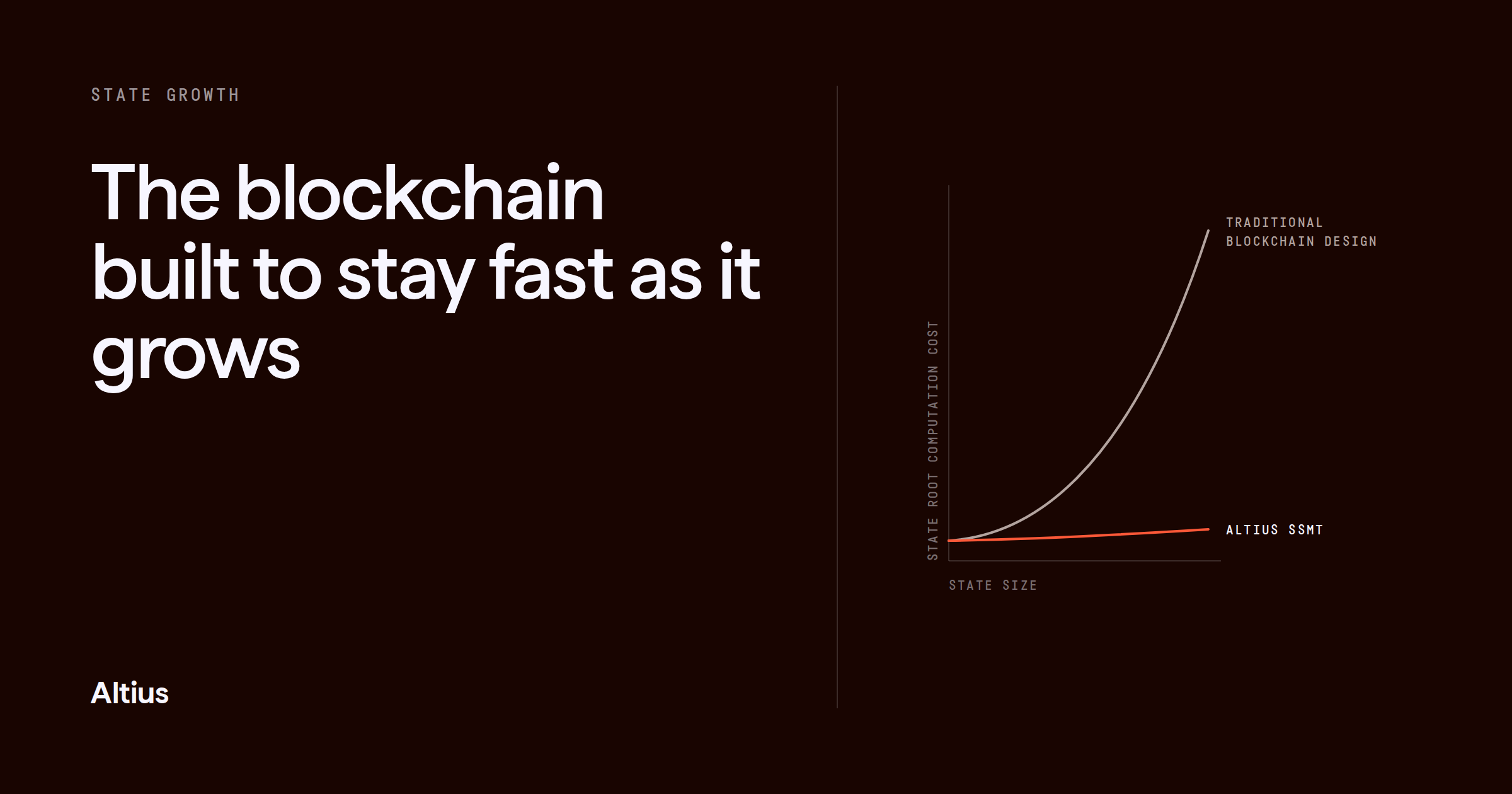
Scalability isn't only about transactions per second. It's also about managing state growth and the long-term cost of running infrastructure, a pressure L2s and new rollups increasingly feel. Altius addresses this with sharded, parallelized state storage and a memory-first, horizontally scalable design. High throughput stays achievable on commodity hardware, so teams don't trade decentralization for speed or depend on specialized machines.
A positive-sum path for a multi-chain world
Adding more rollups, more L2s, and more block space tends to increase fragmentation: applications spread thin, liquidity splits, and developers absorb more complexity. Altius takes the opposite path by making existing block space more performant. Execution gets faster, costs fall, the experience improves, and chains scale without redesigning their architecture, benefiting the wider ecosystem rather than any single network.
This post covers a conversation with Decentralized.co.